
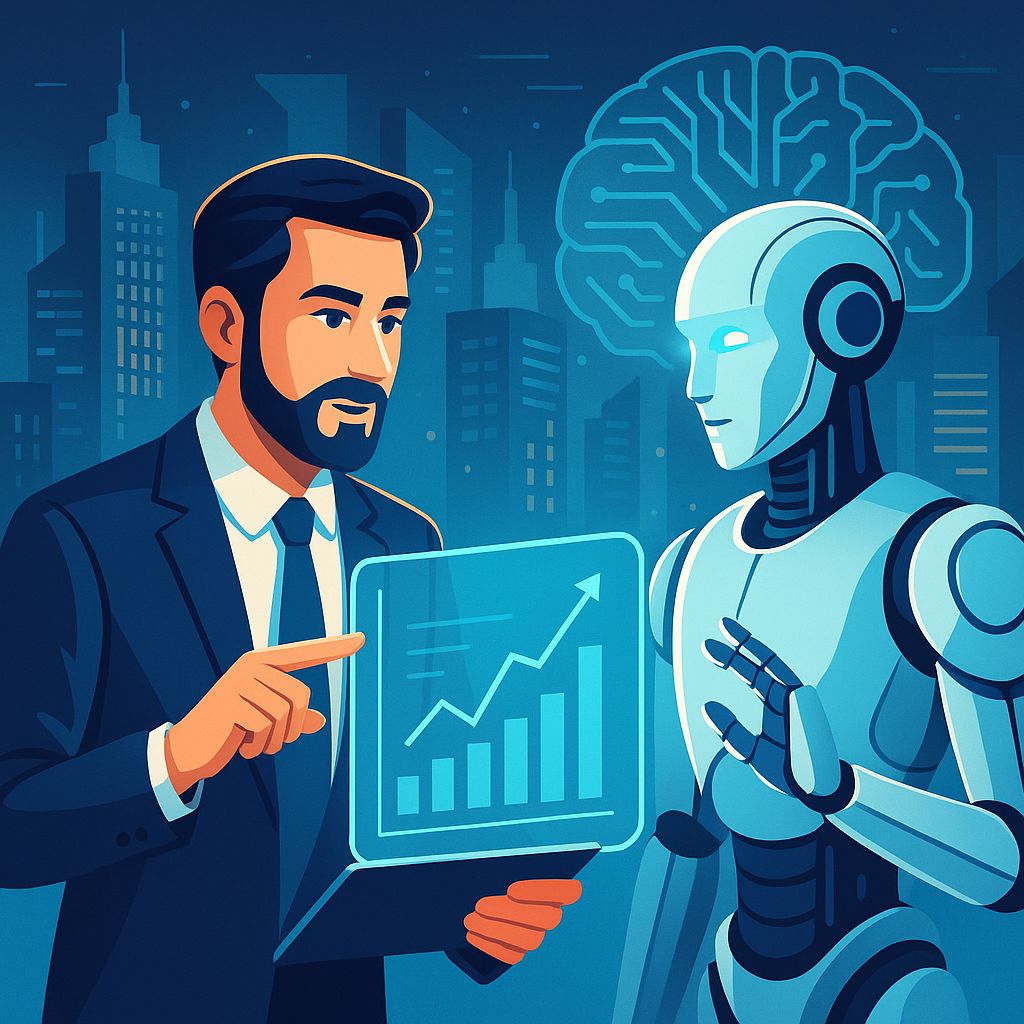

How Artificial Intelligence is Revolutionizing Our World: Present and Future
Artificial Intelligence: A Revolution with Historic Significance
Artificial Intelligence (AI) is far more than just another technological advancement. Its impact is already comparable to the great revolutions that have shaped human history — from the invention of the wheel to industrialization. Without resorting to exaggerated analogies, it’s clear that AI, with its ability to process massive amounts of data and learn autonomously, is profoundly reshaping our societies.
For the first time, we are facing an intelligence designed by humans, yet capable of surpassing some of our own abilities. It’s not just our tools evolving — it’s the very way we create, work, and make decisions that is undergoing transformation.
In my view, AI is steadily becoming a driving force of innovation, as pivotal as the steam engine or electricity were in their time. We are entering an era where those who understand and master these technologies will actively shape the economy and society of tomorrow.
Stanford HAI considers AI to be on track to become the most transformative technology of the 21st century, while McKinsey estimates that generative AI could add between $2.6 and $4.4 trillion annually to the global economy.
Models like GPT-4 have demonstrated human-level performance across various professional and academic benchmarks. In 2023, according to its official technical report, GPT-4 notably passed a simulated bar exam (Uniform Bar Exam) with a score ranking it among the top 10% of participants.
To date, no official update has been released regarding this specific benchmark in 2024 or 2025.
Since then, the AI landscape has seen a spectacular acceleration with the emergence and evolution of numerous large language models (LLMs), including:
- GPT-4o and GPT-4.1 – developed by OpenAI
- Claude 3.5 and Claude 3.7 – by Anthropic
- Gemini 2.5 – by Google DeepMind
- Le Chat – from Mistral AI, a leading European open-source player
- DeepSeek-V2 – by DeepSeek AI
- Llama 3 – developed by Meta, a major reference in open-source models
- Community-driven initiatives like GPT-0.3 and O4
Every week, new models emerge or reach new milestones, reflecting a global race for innovation between tech giants, specialized startups, and open-source communities. These advancements focus on ever-improving reasoning abilities, contextual understanding, and multimodal interaction (text, image, audio). However, most models no longer systematically publish results on traditional academic benchmarks like the bar exam, choosing instead to highlight real-world applications and overall performance.
Sources : Stanford HAI 25 april 2025 The next productivity frontier | McKinsey Live | McKinsey & Company 14 june 2023
Powerful Tools for Productivity Enhancement
Today, AI primarily acts as a talent amplifier. It handles repetitive tasks — email sorting, report generation, content moderation — freeing up time for strategic thinking and creativity. I’ve seen firsthand, through internal projects, how AI assistants accelerate tasks like drafting specifications or summarizing meetings, without ever replacing human intuition.
The example of the calculator illustrates this well: it didn’t eliminate mathematicians; it enabled them to push analytical boundaries further. Similarly, a marketer or designer lacking AI literacy will struggle to leverage its full potential — expertise remains essential to guide and interpret AI outputs.
A study on customer support agents using a generative AI-based conversational assistant showed a 14% average increase in productivity, with a 34% improvement for novice and less-skilled workers. AI assistance seems to spread best practices from experienced employees and helps newcomers progress faster.
Source : Economic potential of generative AI | McKinsey
Which Professions Are Being Reshaped by AI – Far Beyond Automation
Rather than simply discussing “replacement by machines,” today’s language models are profoundly transforming both the nature of work and the type of thinking required to perform it.
While repetitive and standardized tasks like data entry or invoice processing can indeed be automated, the real challenge now lies in the ability of these tools to handle complex reasoning, synthesize knowledge, and stimulate creativity.
Why It’s No Longer Just About Automation
Scientific Discoveries and Medicine:
The AI Co-Scientist tool from Google DeepMind, based on Gemini 2.0, is designed to assist researchers in generating hypotheses, drafting experimental protocols, and preparing scientific publications. Its clear objective is to accelerate the pace of scientific and biomedical breakthroughs, even though the exact impact on research timelines has not yet been quantified.
Meanwhile, AlphaFold 3, developed by DeepMind and Isomorphic Labs, is revolutionizing the prediction of complex molecular structures and interactions, opening new perspectives in understanding biological systems and advancing drug discovery.
Medical Diagnostics:
A study published in 2024 in JAMA Network Open showed that AI models like GPT-4 achieve better results than doctors in certain isolated diagnostic scenarios. However, the integration of these tools into clinical practice has not yet demonstrated a significant improvement in diagnostic reasoning compared to traditional methods. These results primarily highlight the potential of AI as a complementary tool, with its full effectiveness depending on better integration into medical workflows.
Creative Industries:
According to Microsoft, AI is progressively transforming the role of designers, steering them toward more ideation, curation, and creative direction, rather than merely executing tasks. Although no specific figures were provided, testimonies emphasize that tools like Copilot allow creative professionals to focus more on the broader vision and strategic design elements, while AI handles more repetitive or technical aspects.
Research and Innovation:
A study by the Stanford Human-Centered AI Institute (HAI) demonstrated that teams combining human intelligence and AI during brainstorming sessions generate 37% more viable ideas compared to teams composed solely of humans or solely of AI. This result perfectly illustrates how AI can become a true thinking partner, enhancing creativity and innovation beyond simple task automation.
Artificial Intelligence is no longer just about replacing repetitive tasks: it now plays an active role in reflection, creativity, and innovation. Whether in laboratories, hospitals, design agencies, or R&D departments, AI is emerging as a strategic ally to push the boundaries of human potential — provided it is well integrated and properly managed.
For SMEs, the real challenge is not job loss, but the rapid acquisition of skills needed to integrate these tools effectively and turn them into a competitive advantage.
Sources: AI and Creativity: The 2025 Guide Every Innovator Needs – Accelerating scientific breakthroughs with an AI co-scientist – Google DeepMind and Isomorphic Labs introduce AlphaFold 3 AI model – Microsoft’s design chief on human creation in the AI era – JAMA Network Open
The Risks of a Two-Tier AI Economy
My biggest concern is the growing divide between:
- Tech giants capable of investing hundreds of millions into supercomputers and ultra-powerful models;
- Small businesses and emerging countries, forced to rely on limited or more expensive services.
This duality could widen the gap in productivity and innovation: the former will hold unbeatable strategic advantages, while the latter remain dependent, facing economic and political exclusion risks. Without efforts in resource sharing, open-source models, and massive training, we risk seeing an “AI elite” emerge, leaving much of the world technologically behind.
The high costs of AI development and deployment could restrict access to the most advanced models to only a few major tech companies. This could lead to unequal access to AI’s benefits, with smaller businesses and less wealthy nations relying on less efficient versions or delayed innovations.
Researchers, including those at MIT Sloan, warn that AI could have mixed effects on inequality.
On one hand, generative AI might reduce wage gaps by making advanced skills more accessible through automation. On the other, it could widen disparities between companies — those who master AI will surge ahead, while others lacking resources or expertise will lag behind.
Without proper support to help workers transition and manage related risks, AI may indeed boost economic growth but at the cost of deepening inequalities. Responsible adoption is key to ensuring these technologies benefit everyone and truly contribute to a fairer, more sustainable future.
The World Economic Forum emphasizes the need for multi-stakeholder collaboration to prepare workers, businesses, governments, and educators for upcoming disruptions, promoting fair social, environmental, and technological transitions.
Sources : MIT Sloan 29 march 2024 – World Economic Forum october 2023
My Vision for AI: Balancing Opportunities and Caution
At e-novateur, we believe AI must remain a tool serving humanity, not the other way around. Three core principles guide our approach:
- Democratization: Promote and integrate open-source models or accessible subscription solutions so every business can benefit.
- Digital Sobriety: Share computing resources, optimize algorithms, and prioritize green data centers to reduce environmental impact.
- Ethics and Transparency: Ensure traceability of algorithmic decisions, protect personal data, and involve diverse supervisory committees.
By keeping humans at the heart of every project, AI can become a sustainable and inclusive driver of innovation. History may remember this era as the moment when we collectively transformed a powerful discovery into a universal public good — much like the mastery of fire or the invention of the wheel.